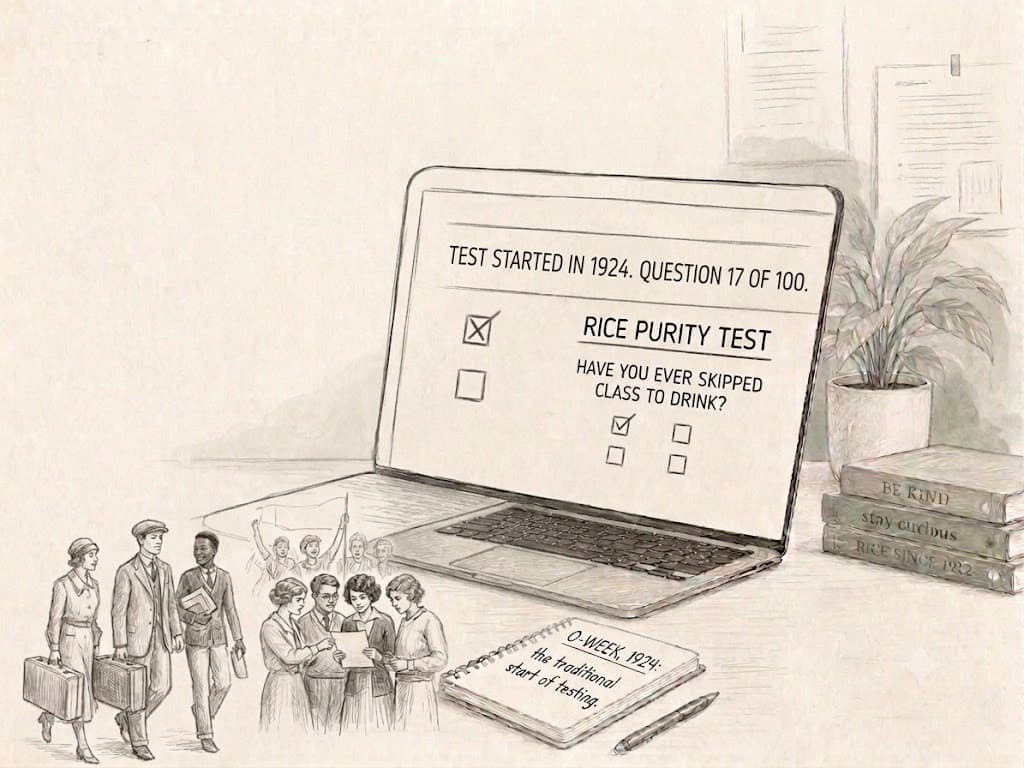
Orientation Week — the first 5–10 days of college life when incoming freshmen meet their classmates, learn the campus, and start the transition from high school student to college student — is one of the most psychologically loaded weeks of the entire college experience. Decisions made and friendships formed during O-Week set patterns that persist for the next four years.
The Rice Purity Test was created at Rice University in 1924 specifically as an O-Week activity. It wasn't designed as a personality assessment or a viral quiz. It was designed as a bonding tool for students who'd known each other for less than 72 hours. A century later, the test has accumulated millions of users and TikTok virality, but the O-Week origin still explains why the test works the way it does.
What O-Week actually is
O-Week (also called Orientation Week, Welcome Week, or various other school-specific names) is the structured first week of the college experience at most American universities. Incoming freshmen arrive on campus, get assigned dorm rooms, meet their floor-mates, attend mandatory information sessions, navigate the bureaucratic infrastructure of college life, and spend significant time in groups designed to build initial social connections.
For students at residential colleges, O-Week is also the first sustained period away from family supervision. Many students have their first taste of independent living during this week — staying up as late as they want, deciding when and what to eat, choosing their own social circles. The combination of independence and structured activity creates a unique psychological context.
Why O-Week needs bonding activities
Students arriving for O-Week face a specific social problem: they need to form genuine friendships with strangers in a compressed timeframe. The casual social discovery that happens naturally over months or years has to be compressed into days. Standard small talk doesn't work — there isn't time for the gradual revelation of personality and shared values that normally drives friendship formation.
This is why universities have spent the past century developing increasingly elaborate O-Week activities: structured games, group challenges, late-night discussions, ritualized vulnerability exercises. Each activity is designed to compress months of normal social discovery into hours of intense shared experience.
The Students Purity Test fits into this ecosystem with unusual precision. It produces specific things to talk about. It surfaces personal information that wouldn't normally come up so quickly. It creates a shared experience (everyone took the same test). And it generates a single comparable artifact — your score — that gives everyone in the group a baseline reference point for further conversation.
What the original Rice version was for
In its 1924 form, the Rice Purity Test was significantly shorter and more obviously a bonding activity than the modern 100-question version. The original questions covered behaviors that 1920s Rice students would consider mildly transgressive — riding in cars unchaperoned, dancing closely, smoking, staying out past dorm curfew. The score served as a quick way to identify which freshmen were stricter, which were more rebellious, and where the conversations would need to start.
Students would take the test together in their O-Week groups, often led by upperclassmen serving as group leaders. The leader would read questions aloud, students would track their own answers privately, and the final scores would be shared at the end with the surrounding context that nothing about the score should be taken seriously. The point was the conversations the test generated, not the numbers themselves.
This original framing — group activity, low-stakes scoring, conversation-as-purpose — is why the test felt different from a serious assessment. The Rice Thresher published it as entertainment, students took it as entertainment, and the social bonding emerged as a side effect.
The Rice Purity Test was never meant to be taken seriously as a measurement of anything. The 1924 original was more like a structured icebreaker than a personality test. This framing is part of why the test has remained so durable — it doesn't need to be psychologically valid to do its actual job, which is sparking conversations.
Why the tradition outlasted the original purpose
Most college traditions fade as the conditions that created them change. The Rice Purity Test should logically have faded by now: the 1924 anxieties about dancing and chaperones aren't relevant to modern students, the gendered original framing is uncomfortable to defend, and the test has expanded far beyond its original O-Week scope.
But the tradition persists, and the explanation is functional. The Rice Purity Test still does what it was originally designed to do: create structured shared experience for groups of strangers in compressed timeframes. The specific questions have evolved, but the underlying social mechanic hasn't. Groups of 18-year-olds meeting each other for the first time still benefit from a tool that surfaces personal information quickly while keeping the stakes low.
This is also why the test has spread well beyond Rice University. Other schools adopted it because the function it served at Rice transferred cleanly to their own O-Week contexts. Berkeley, UCLA, Duke, and dozens of other universities developed local variations because the underlying social problem (rapid bonding among new freshmen) was identical to the one Rice faced.
How modern O-Week groups still use it
The modern O-Week version of the Rice Purity Test typically happens 3–7 days into orientation, after groups have spent enough time together to feel comfortable but before the official orientation programming has ended. The test usually appears in one of three contexts:
Dorm floor activities. Resident assistants or floor leaders organize informal evening activities that include the test as one of several bonding exercises. The 8-minute test fits cleanly between other activities and produces immediate conversation material.
Greek life recruitment. Fraternities and sororities sometimes use modified versions of the test as part of their rush activities, particularly during informal gathering events. The format works well for groups of 10–15 people getting to know each other simultaneously.
Friend group formation. Less formally, groups of 4–8 students who've started clustering together during O-Week often take the test together as one of their first shared activities. This is the closest modern analog to the original 1924 use case at Rice.
O-Week format
- Group of 4–10 people takes it together
- One person reads questions aloud
- Everyone tracks their own score privately
- Scores shared at the end with discussion
- Conversations about specific questions matter more than the numbers
Solo TikTok format
- Individual takes test for camera
- Reactions to specific questions are the content
- Score reveal is the climax
- Comments and duets generate discussion
- The single shareable number is the artifact
What modern groups get wrong
The biggest difference between the original O-Week format and how the test gets used today is the de-emphasis on conversation. TikTok-driven solo reactions produce great content but skip the actual social purpose of the test. The conversations that drove a hundred years of O-Week tradition rarely happen in modern viral video form.
Groups that recreate the O-Week format tend to get more value from the test than groups that just compare scores in a chat thread. The pattern that worked in 1924 still works in 2026: read questions aloud, track scores privately, share at the end, then talk about what the test surfaced.
Take it the original way
Get a group of 4–10 people together. Take the test simultaneously. Share scores. Then talk for an hour. The format that's worked for 100 years.
Start the Test →The hundred-year lesson
The Rice Purity Test has survived a century because it solves a real social problem in a specific kind of context: groups of strangers who need to bond quickly. Every cultural moment the test has had — the 1924 origin, the 1980s standardization, the 2010s online expansion, the 2024 TikTok virality — has been variations on the same fundamental utility.
If you're a college freshman taking the test during your O-Week, you're participating in the original tradition. The test was designed for exactly your situation. The conversations you have with your O-Week group after sharing scores are the experience the test was built to produce. A hundred years of Rice Thresher students before you have done the same thing.
If you're taking the test outside the O-Week context — solo on TikTok, with an established friend group, with a romantic partner — you're using the test for something other than its original purpose. That's fine, but the experience won't quite map to what made the test a tradition in the first place. The original O-Week format is still the version of the test that works best at doing what the test was originally designed to do.