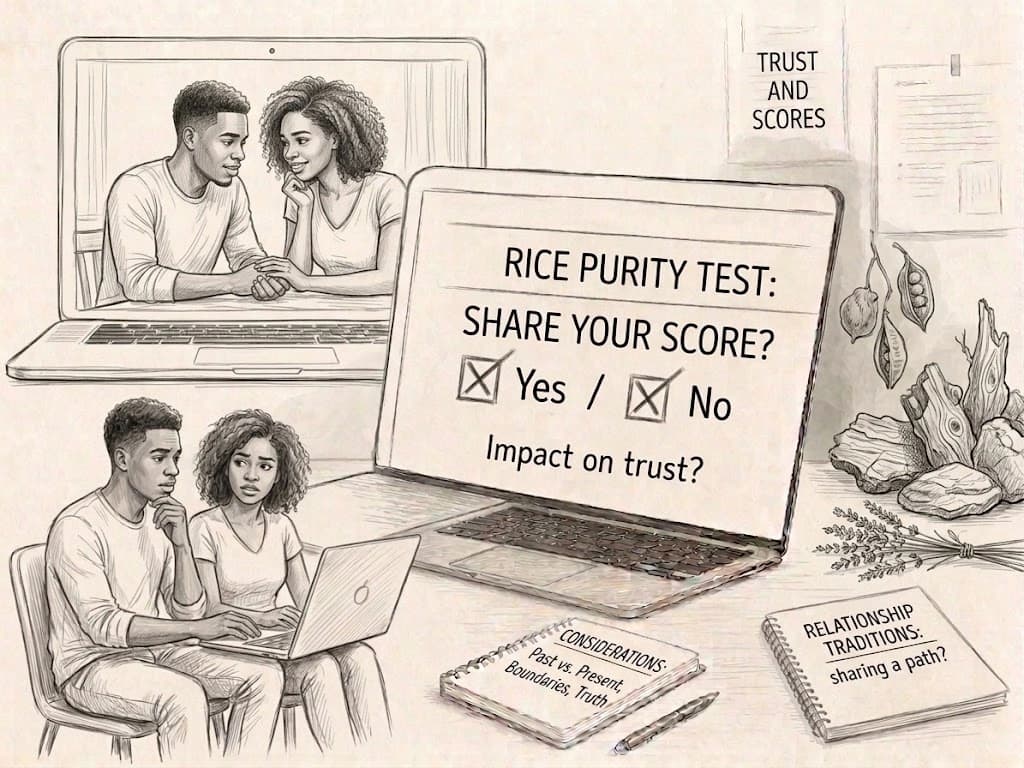
Sharing a Rice Purity Test score with a partner is one of those activities that can either deepen a relationship or create surprisingly persistent friction, depending entirely on how it's handled. The test's binary scoring format — a single number representing your past — is structurally tempting to use as a scoreboard, which is exactly the wrong way to use it.
This guide covers when sharing your score with a partner makes sense, when it doesn't, and how to handle the conversation if you decide to do it.
The case for sharing
Couples who take the Rice Purity Test together and share scores frequently report that the experience strengthens their relationship. The mechanism is consistent: the score itself becomes secondary, but the conversations sparked by specific questions and gaps reveal stories and dimensions of partners' lives that hadn't come up in normal conversation.
A long-term relationship contains thousands of unstated experiences on both sides. The test's 100 specific questions create a structured way to surface them. "Question 47 — when did that happen?" becomes a story-prompting question that wouldn't have come up otherwise.
While the 62% figure is for friend groups generally, the same pattern holds for romantic partnerships when both people approach the conversation with curiosity rather than judgment.
The case against sharing
Sharing scores backfires when one or both partners treat the numbers as a scoreboard. Common failure modes:
Score-as-character-judgment. One partner interprets a low score as evidence of moral failure or untrustworthiness. This usually says more about the judging partner than the judged one — the test isn't a moral instrument — but the damage to the relationship is real regardless.
Score-as-compatibility-test. A large gap between partners' scores gets interpreted as evidence of incompatibility. There's no statistical basis for this interpretation. Couples with 30-point gaps can have wonderful relationships. Couples with identical scores can be entirely incompatible. Treating the gap as predictive misuses the data.
Score-as-permission-slip. One partner uses their score as evidence that they "should" do certain things, framing the unchecked items as opportunities rather than choices. This treats the test as a bucket list, which is the opposite of how it's designed.
If your relationship has unresolved trust issues or active conflicts about your respective pasts, sharing Rice Purity Test scores will not help — and will likely make things worse. The test isn't a therapy tool. Resolve the underlying issues first, then take the test for fun afterward.
How to share scores well
If you've decided to share, the approach matters more than the score itself. The standard format that produces the best conversations:
Take the test independently, in advance
Each partner takes the test alone, ideally on different days. This eliminates any temptation to soften answers based on what your partner is checking next to you. The test only produces meaningful results if both people answer honestly, and honesty is harder when your partner is watching.
Share scores before discussing specifics
Reveal your numbers to each other first. Don't preemptively explain or justify before the score is on the table. The shock value (or lack thereof) of the bare number sets the tone for everything that follows.
Let curiosity drive the conversation
Once both numbers are out, the interesting conversation isn't about the scores — it's about specific questions. "What was section 4 like for you?" "Was anything in section 6 something I'd be surprised about?" These open-ended prompts produce real conversations. Compare-the-numbers conversations don't.
Don't show each other your specific answers
Sharing the final score is one thing. Showing each other which exact items you ticked is another. The standard convention is to share the total, discuss themes, and leave the box-by-box specifics private. This protects the dignity of past relationships, past partners, and past versions of yourselves.
What to do if there's a big score gap
Score gaps between partners are normal and don't mean what people sometimes worry they mean. A 25-point gap doesn't indicate incompatibility. A 5-point gap doesn't indicate compatibility. The gap reflects different past experiences, not different future potentials.
The most useful framing if you're staring at a gap: each of you has had the life you've had, and that life was happening before you knew each other. The score is a static fact about your respective pasts. Your relationship is about what you build going forward. Treating past experiences as currently relevant variables in a present-tense relationship is a category error.
If a gap genuinely bothers one partner, the issue is rarely the gap itself — it's usually some unstated concern about trust, compatibility, or future expectations. Address the underlying concern directly. The Rice Purity Test isn't an effective proxy for that conversation.
When to skip the test entirely
Some couples should not take the Rice Purity Test together. The test is poorly suited to relationships where:
- One partner has explicit anxiety about the other's past
- There's an active conflict about trust or fidelity
- One partner is significantly more invested in scoring than the other
- The relationship is new (less than 3 months) and these conversations haven't happened naturally yet
- One partner has expressed religious or moral concerns about the test's content
In any of these cases, taking the test together creates more risk than reward. Wait until the relationship is in a different place, or skip it entirely. Plenty of strong long-term relationships exist without ever taking the Rice Purity Test together.
Ready to take it together?
Each partner can take the test independently, then come back to compare scores. Eight minutes per person, completely private.
Take the Test →The bottom line
Sharing your Rice Purity Test score with your partner is a tool — a structured way to spark conversations about your respective pasts. Like any tool, it works when used correctly and backfires when used incorrectly. The right use is curiosity-driven conversation about specific experiences. The wrong use is treating the score as a measurement of character, compatibility, or worth.
If you're going to share, share well: take it independently, share scores before specifics, let curiosity lead, and protect the box-by-box privacy of your individual answers. If you're going to skip, skip entirely — there's no value in a half-shared, half-defensive version of this conversation.
The test's value is in the conversations it sparks, not in the numbers themselves. Approach it that way and the experience adds something to your relationship. Approach it as a scoreboard and it adds tension you didn't need to add.