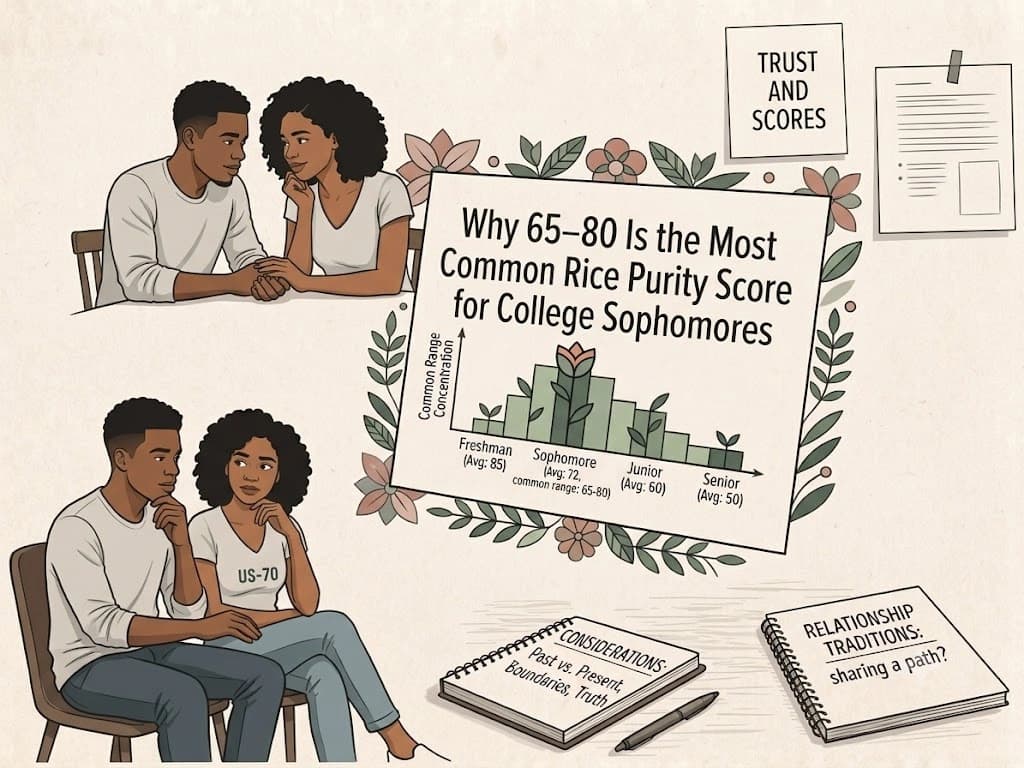
If you ask a hundred random college sophomores for their Rice Purity Test scores, roughly 38 of them will report a number between 65 and 80. That's a remarkable concentration — almost two-fifths of the entire age cohort packed into a 16-point band, with the surrounding 84 points of the score range absorbing the remaining 62%.
This concentration isn't random. It reflects a specific combination of cumulative life experiences, age-bound social patterns, and the actual content of the 100-question Online Purity Test For Collage. Understanding why 65–80 dominates the college sophomore distribution reveals more about how the test works than almost any other statistical pattern.
What "college sophomore" actually captures
The college sophomore demographic — typically 19–20 years old, in their second academic year — sits at a specific point in the test's natural curve. They've completed enough of college to have moved past the freshman score range (typically 80–95), but haven't accumulated enough additional experiences to drop into the typical 25-and-up range (60–70). They're squarely in the middle of the test's most experience-dense life stage.
The 65–80 range is wide enough (16 points) that it accommodates real variation: sophomores at religious universities cluster toward the top (75–80), sophomores at large state schools cluster toward the middle (70–75), and sophomores at urban liberal arts colleges with active social scenes cluster toward the bottom (65–70). Each segment averages within a few points of the other, but the broader band absorbs them all.
The math behind 65–80
The Rice Purity Test asks 100 binary questions across six thematic sections. A score of 65 means 35 items checked. A score of 80 means 20 items checked. The 16-point range captures students who've checked between 20 and 35 of the 100 items.
What does that look like in practice? A typical sophomore in this range has likely:
- Completed most of section 1 (affection and romance) — 12–15 items checked
- Started section 2 (intimacy) — 5–10 items checked
- Begun section 3 (substances) — 3–8 items checked
- Touched section 4 (legal/authority) — 0–3 items checked
- Started section 5 (sexual experience) — 0–4 items checked
- Not yet entered section 6 (deeper waters) — 0 items
This profile describes a student who's had at least one significant relationship, regular social drinking, occasional substance use, perhaps a brush with university discipline (an underage drinking ticket, a noise complaint), and some sexual experience without extensive variety. It's the modal college experience captured in checkbox form.
Why the band is wide rather than tight
You might expect a tighter cluster — say, 70–75 — given how similar most college sophomores' lives appear from the outside. The 16-point spread reflects three sources of variation that the average obscures.
Pre-college variation. Some sophomores arrived at college with score gaps of 10+ points already in place from high school experiences. Two students who lived identical sophomore years can have wildly different scores because their freshman years (or pre-freshman years) differed.
School-type variation. A sophomore at Brigham Young University will average around 80–82. A sophomore at NYU will average around 65–68. The 16-point range captures both, with the bulk of large state schools clustering in the 70–75 middle.
Lifestyle variation within schools. Even within a single university, students in Greek life average 5–8 points lower than non-Greek students. Athletes average 3–5 points lower than non-athletes. Students in social-heavy majors (journalism, communications) average 3–4 points lower than students in traditionally bookish majors (mathematics, physics).
These three variation sources stack on each other, which is why a single school's sophomore distribution still spreads across the full 65–80 range despite all those students living similar lives.
What happens after sophomore year
The interesting pattern is what happens to this concentration over the next two years. By senior year, the same students have typically dropped 5–8 points each, but they've also spread out more widely. The senior-year distribution covers roughly 55–80, with the median around 65–68.
This widening reflects how the post-sophomore years amplify variation. Some students enter long-term relationships and stop accumulating experiences in the test's catalogue. Others have their most exploratory years between 20 and 22. The same sophomore class that was tightly clustered in the 65–80 band ends up spread across a 25-point range by graduation.
The Rice Purity Test was originally designed at Rice University in 1924 for exactly this purpose — measuring the change in students between freshman year and senior year. The sophomore-to-senior trajectory is the test's intended use case, not the single-point-in-time snapshot most people take it for.
What this means for your sophomore score
If you're a college sophomore who took the test and scored somewhere in the 65–80 range, your score is unremarkable in the most literal statistical sense — it places you in the largest single demographic cluster on the test. That doesn't make the score uninteresting, but it does mean comparison to your peers will mostly produce surprisingly similar numbers.
If you scored above 85 as a sophomore, you're either at a religiously affiliated university, in a particularly conservative social environment, or genuinely have less experience accumulation than your cohort. None of these are problems — the test isn't a bucket list — but they do mean you're an outlier within sophomore data.
If you scored below 60 as a sophomore, you've either had an unusually intense early college experience, came in with significant pre-college experience, or are at a school with a particularly active social scene. The lower-end sophomore scores are real and don't indicate anything beyond accumulated experience density.
Curious where your exact score lands?
Every individual score from 0 to 100 has its own page with detailed analysis, percentile placement, and demographic context.
Browse Score Pages →The persistence of the 65–80 cluster
What's most striking about the 65–80 dominance is how stable it's been across decades. Public data from the 1990s shows the same sophomore concentration in the same band. Data from the 2010s shows it. Modern 2026 data shows it. Through cultural shifts, generational changes, and the test's TikTok virality, the modal college sophomore score has remained 65–80 with remarkable consistency.
This consistency suggests the cluster reflects something fundamental about the structure of college life rather than any cultural moment. The 100-question Rice Purity Test, as it currently exists, is calibrated such that completing two years of college produces 20–35 checked items for most students. This calibration was unintentional — the test wasn't designed to produce a specific sophomore band. But after 100 years of refinement, that's the band it produces.
The next time you hear someone say their college sophomore score and the number falls in the 65–80 range, you'll know exactly what bucket they're in: the largest single demographic cluster on the entire test, defined by a combination of mathematics, college life patterns, and a hundred years of question evolution.