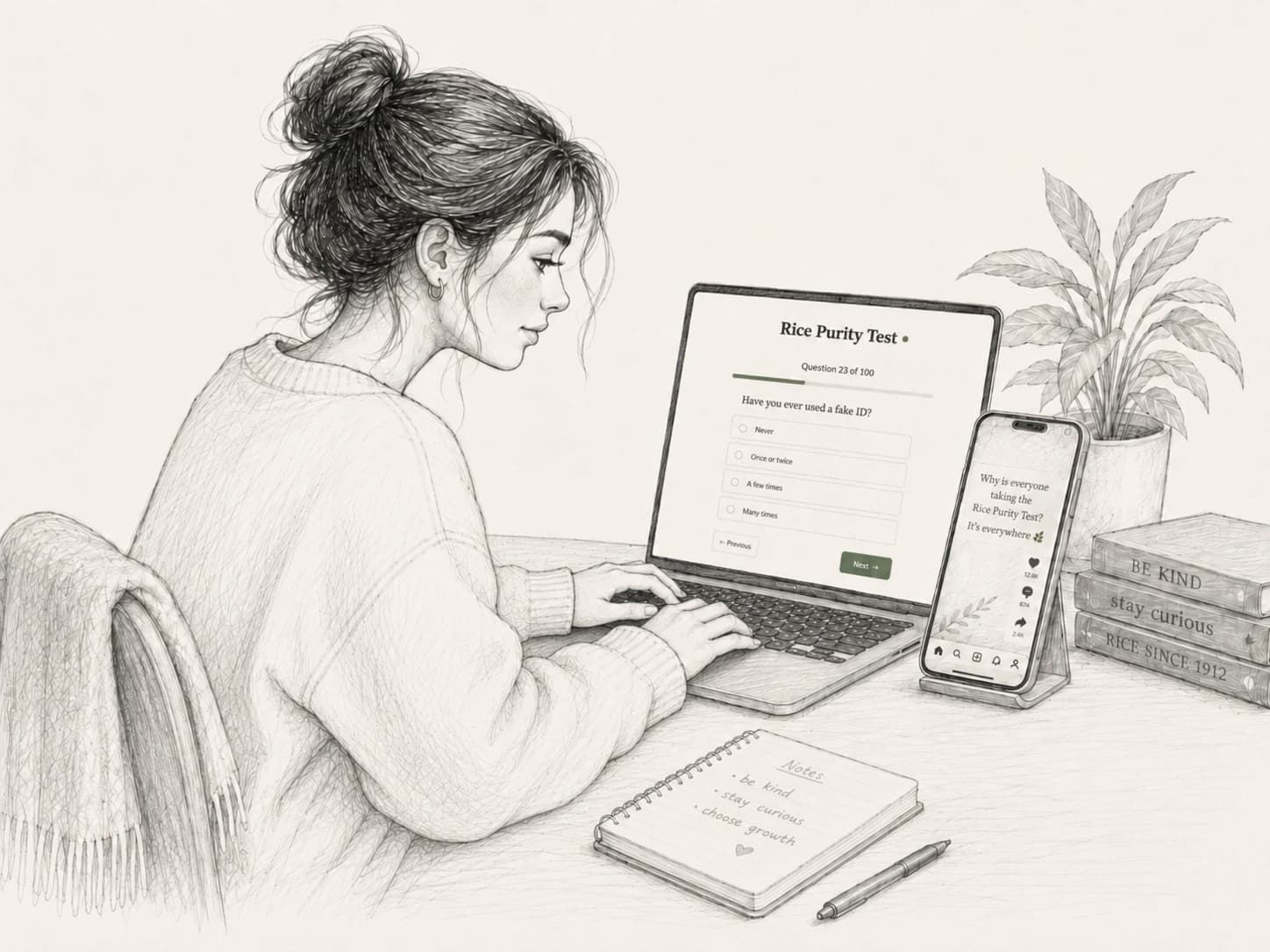
In late 2023, a 100-year-old college questionnaire from Rice University started showing up in TikTok feeds at a scale that no one — including the Rice Thresher itself — could have predicted. By mid-2024, videos tagged with #ricepuritytest had accumulated hundreds of millions of views. Reaction videos to specific questions became their own micro-genre. Group-chat score comparisons turned into a cultural ritual among Gen Z friend groups.
The Rice Purity Test had existed online for over a decade before this moment. It had been a niche curiosity for the entire 2010s. Then, suddenly, it was everywhere. The viral explosion wasn't random — it followed predictable patterns that explain why some content goes viral and other content doesn't.
The format was perfect for TikTok
Most successful TikTok content shares a few specific properties. It produces visible reactions. It invites participation through replication. It creates shareable artifacts. The Rice Purity Test happens to maximize all three.
Visible reactions are built in. Watching someone read question 47 ("had intercourse with a third party in the same room") and seeing their face respond is genre-defining short-form video. Reaction videos to specific questions became their own internal subgenre.
Participation is built in. Every reaction video carries an implicit "what did you score?" The format invites duets, stitches, and response videos. One creator's score creates a comparison opportunity for hundreds of others.
Shareable artifacts are built in. The score itself is a single two-digit number that everyone watching instantly understands without context. "I got a 73" requires no explanation. This made the test infinitely shareable across platforms — Instagram Stories, group chats, dating app profiles, Twitter screenshots.
The timing was perfect
The first viral wave appeared in early 2020 during pandemic lockdowns. College students were home, bored, and looking for ways to connect with friends remotely. The Rice Purity Test provided exactly the right kind of structured social activity — something you could do over a video call, that produced specific things to talk about, that didn't require shared physical space.
The second viral wave, in 2023–2024, hit during a different cultural moment. TikTok's algorithm had matured to the point where niche content could find massive audiences quickly. Gen Z had developed a strong taste for retro-feeling content (everything from Y2K aesthetics to nostalgic college rituals). A 100-year-old test from a campus newspaper had exactly the right vintage credibility.
The cultural openness made it work
Earlier generations would have struggled to make the Rice Purity Test viral because earlier generations were more reluctant to publicly discuss the topics the test covers. Gen Z's general openness about relationships, sexual experience, mental health, and substance use removed the awkwardness barrier that had kept the test as a whisper-network artifact in earlier decades.
On TikTok specifically, this openness combined with a culture of confessional content. Telling-on-yourself videos, story-time formats, and "things I did in my early 20s" reflective content were all established genres. The Rice Purity Test fit naturally into this ecosystem — it was confessional content with a built-in scoring system.
The most successful Rice Purity Test reaction videos didn't just show the score reveal. They paused on specific questions and added personal commentary, turning a solo activity into a one-person podcast. This pattern is now standard for almost any viral quiz content on TikTok.
The cultural legitimacy mattered
Most viral quizzes are dismissible. They feel like Buzzfeed-style nonsense. The Rice Purity Test had something most viral quizzes lack: actual history. The fact that it originated at Rice University in 1924, that it had a real institutional connection to a real student newspaper, that it had survived multiple generations of campus tradition — all of this gave the test a cultural weight that more recent quizzes can't replicate.
On TikTok, this manifested as users frequently noting the test's age in their videos. "This is from 1924" was practically its own subgenre. The history added stakes. Taking the test felt less like answering a Buzzfeed quiz and more like participating in a hundred-year-old ritual.
The friend-group dynamic supercharged it
Most viral TikTok phenomena are individual. You watch them, you maybe share them, you move on. The Rice Purity Test is fundamentally social — the score only becomes interesting when compared to friends' scores. This drove a different kind of viral spread.
Once one person in a friend group took the test, the entire group usually followed within days. Group chats lit up with score comparisons. WhatsApp threads filled with discussions of specific questions. The test wasn't just spreading from creator to viewer; it was spreading from friend to friend within tight social networks.
This is a much faster propagation pattern than typical viral content, because each person who took the test typically introduced it to 5–10 close friends. Surveys suggest 62% of users reported stronger friendships after sharing scores within their friend groups, a remarkable number for any viral phenomenon.
Why the variations matter
The post-viral period (2024–2026) has been defined by variations. Couples versions. Gender-specific versions. Identity-inclusive versions. Age-appropriate versions. Fandom-specific versions for K-pop, anime, gaming, ADHD experiences, and dozens of other niches. Each variation has its own micro-viral moment within its specific community.
The variations are themselves a sign of how culturally significant the original has become. People don't bother making variations of forgettable quizzes. The fact that Gen Z has produced dozens of niche versions of the Rice Purity Test means the original has become genuinely embedded in the culture — it's not just a viral moment, it's a template that communities adapt to their own contexts.
Want to take the original?
The classic 100-question Rice Purity Test takes about 8 minutes. Completely private, no sign-up needed.
Take the Test →What this tells us about virality
The Rice Purity Test isn't a fluke. It went viral because it had every property that viral content needs: instant reactions, built-in participation, shareable artifacts, perfect platform fit, perfect cultural moment, and pre-existing legitimacy that elevated it above ephemeral quizzes. Most viral content has some of these properties; the Rice Purity Test had all of them.
This is also why subsequent attempts to manufacture similar phenomena have mostly failed. You can't fabricate a 100-year history. You can't manufacture genuine cultural legitimacy. The test went viral because the underlying object was genuinely worth going viral.